
Wood Fence Installation in Portland
Handcrafted wood fences in Western red cedar and pressure-treated pine — Portland’s most trusted material for privacy, beauty, and durability.
Western Red Cedar: Portland's Premier Fence Wood
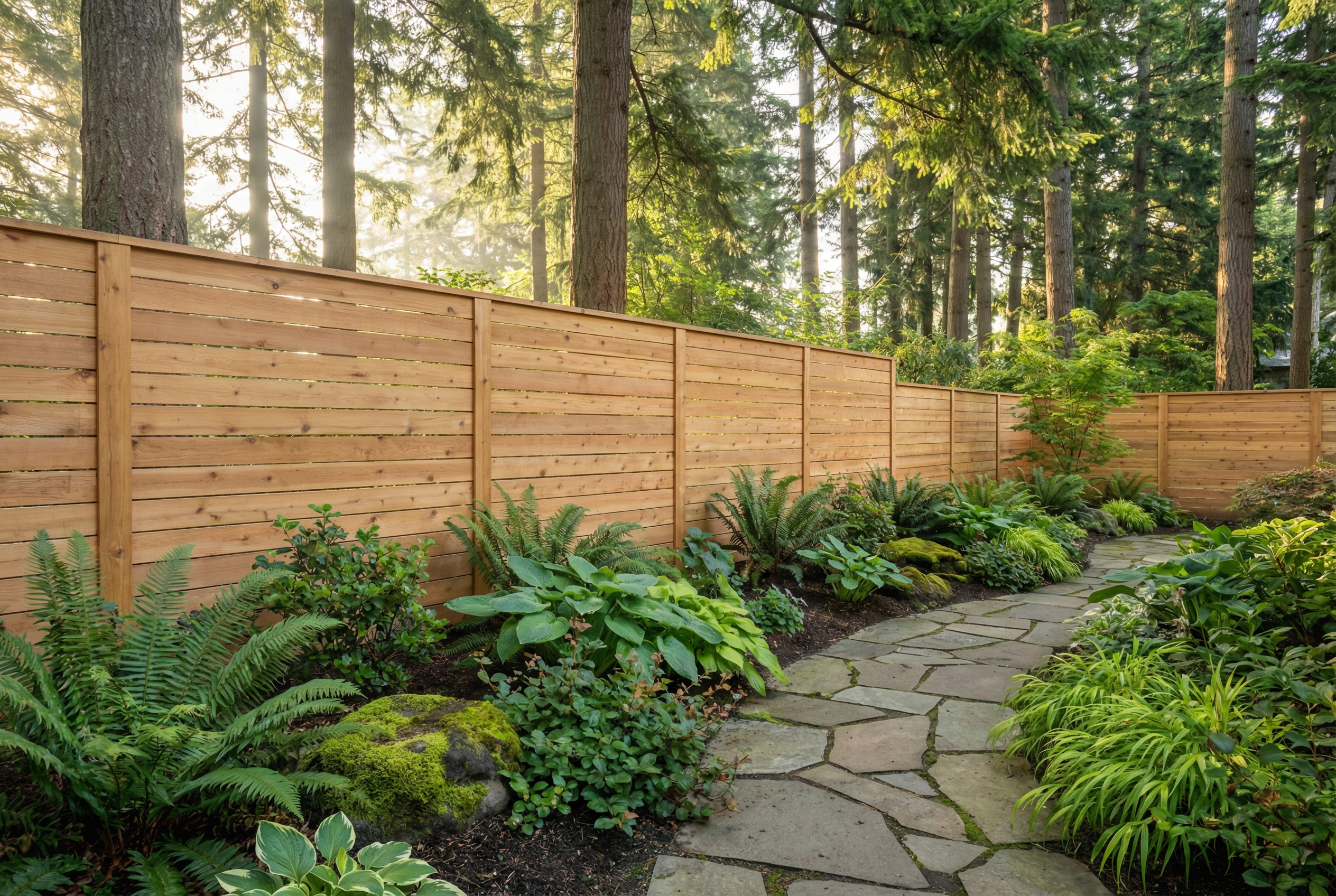
Wood remains the most popular fencing material in Portland, and it is easy to understand why. A well-built wood fence has a natural warmth and character that manufactured materials cannot replicate. The grain patterns, the rich tones of fresh cedar, the way it weathers into a distinguished silver-gray over the years — wood fencing connects your property to the Pacific Northwest landscape in a way that feels authentic and grounded.
Next Level Decks & Exteriors builds wood fences exclusively with Western red cedar and pressure-treated pine — the two wood species proven to perform in Portland’s challenging climate. We offer every major wood fence style from traditional privacy to contemporary horizontal, custom-built to your property’s dimensions and your aesthetic preferences.
The key to a wood fence that lasts in Portland is not just the lumber — it is how the fence is built. Post depth, drainage, fastener selection, and rail attachment methods matter enormously in our wet climate. We build wood fences with the same structural attention we bring to our deck construction, because a fence that falls apart in five years is not a fence worth building.
30yr
Cedar Lifespan
5+
Fence Styles
100%
Natural Wood Beauty
Western Red Cedar: Portland's Premier Fence Wood
Western red cedar has been the fence wood of choice in the Pacific Northwest for generations. It grows abundantly in our region, mills are local (keeping costs competitive), and its natural properties make it ideally suited for our climate.
Natural Rot Resistance: Cedar heartwood contains natural oils (thujaplicins) that inhibit fungal growth and resist insect damage without chemical treatment. This is a significant advantage in Portland, where moisture-related decay is the primary enemy of wood fences. While cedar is not immune to rot — especially the sapwood — it dramatically outlasts untreated softwoods in ground-contact and weather-exposed applications.
Dimensional Stability: Cedar has a lower shrinkage coefficient than most softwoods, meaning it warps, cups, and twists less as it absorbs and releases moisture through Portland’s wet-dry seasonal cycle. Fence boards stay flatter and maintain tighter joints over time compared to pine and fir.
Appearance: Fresh cedar ranges from golden-amber to reddish-brown, with straight, tight grain and a pleasant aromatic scent. Left unfinished, it weathers to a silver-gray patina within 12-18 months — a look that many Portland homeowners deliberately choose. Stained cedar can maintain its warm tones for 2-3 years between applications.
Cedar Grades: We use #1 grade or better fence boards — tight knots, consistent width, and smooth milling. For visible fence faces and premium projects, we use select (clear) grade cedar with virtually no knots. For posts and rails, we use #2 or better structural-grade cedar or pressure-treated posts for ground-contact durability.
Horizontal Cedar Fence Designs
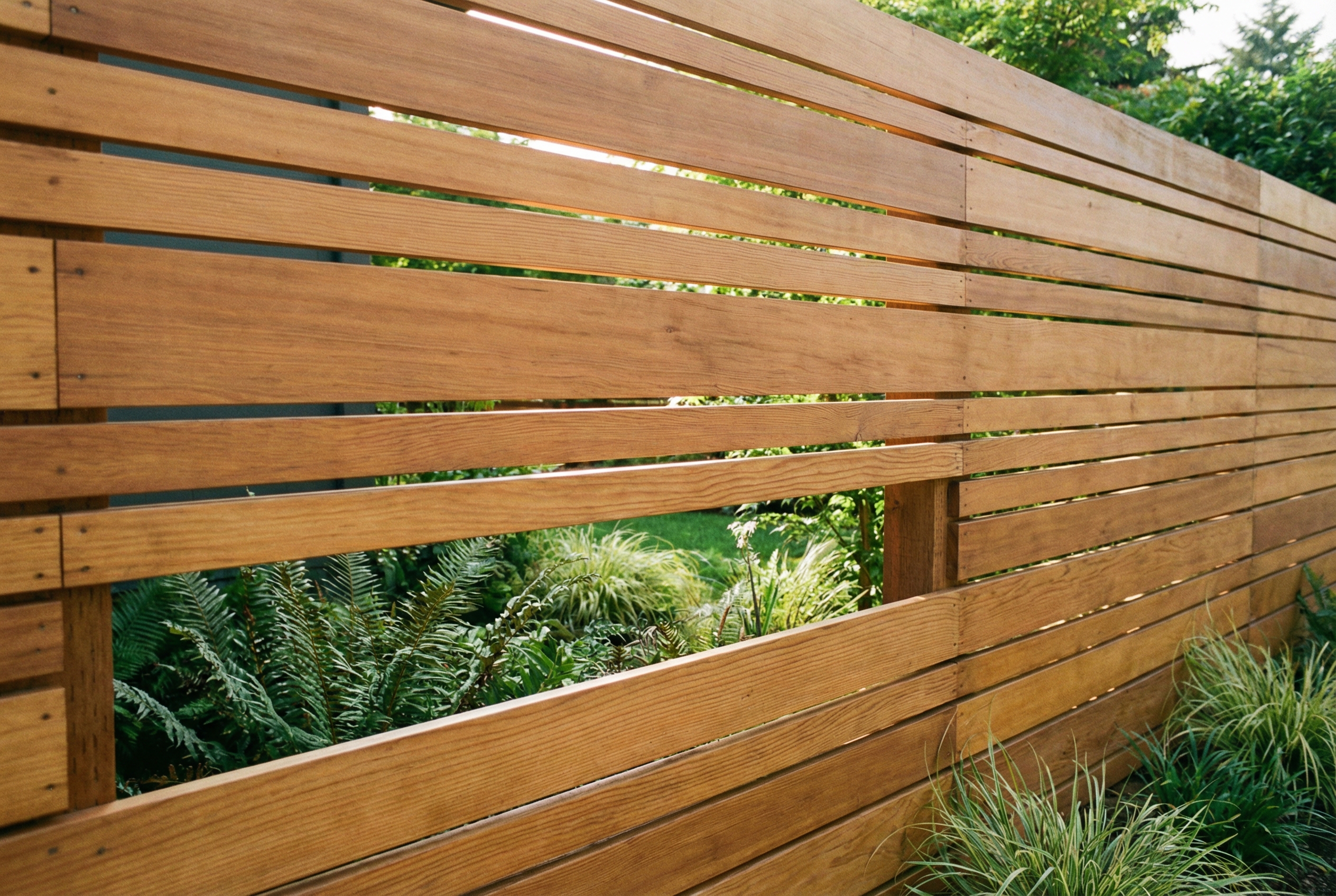
Horizontal cedar fences have become one of our most requested styles in Portland. The clean, linear look pairs beautifully with modern homes and craftsman-style renovations. We use select tight-knot Western red cedar boards, installed with hidden fasteners and precision-milled for uniform spacing that stays straight season after season.
Pressure-Treated Pine: The Value Option
Pressure-treated (PT) pine is the budget-friendly alternative that provides excellent rot and insect resistance through chemical treatment. Modern PT lumber uses micronized copper azole (MCA) or alkaline copper quaternary (ACQ) preservatives that are forced into the wood under pressure, providing protection throughout the board’s cross-section.
Cost Advantage: PT pine fence boards cost approximately 30-40% less than equivalent cedar boards. For a 200 linear foot privacy fence, the lumber savings alone can be $1,500-$3,000. If budget is a primary concern, PT pine delivers solid performance at a lower price point.
Performance in Portland: Modern PT lumber performs well in Portland’s wet climate. The copper-based preservatives resist both fungal decay and insect damage. PT posts rated for ground contact (UC4A or UC4B) can last 20+ years in the soil when properly installed with drainage.
Limitations: PT pine does not have cedar’s natural beauty. Fresh PT lumber has a greenish tint from the copper treatment, and it tends to warp and twist more than cedar as it dries. We recommend allowing PT fence boards to dry for 30-60 days after installation before applying stain or sealant — otherwise the finish will not penetrate properly and will peel within months.
Staining PT Pine: Once dry, PT pine accepts stain well and can look very attractive. Semi-transparent stains allow some grain to show while adding color. Solid-color stains provide the most uniform appearance and hide the natural color variation in PT lumber. We recommend re-staining every 2-3 years in Portland’s climate.
Wood Fence Styles
Wood fencing’s greatest advantage over manufactured materials is versatility. We can build virtually any style, pattern, or custom design in wood. Here are the most popular styles we build in Portland:
Privacy Fence (Dog-Ear): The classic residential fence. Vertical boards (typically 1×6) set tightly together with the top corners cut at 45 degrees. Provides complete privacy with a clean, simple appearance. Cost-effective and universally appropriate for Portland neighborhoods.
Board-on-Board: Overlapping vertical boards mounted on alternating sides of the horizontal rails. The boards overlap by 1-1.5 inches, creating a fence with no visible gaps from either side — and an equally attractive appearance on both sides. Board-on-board uses 30-40% more lumber than standard privacy fencing but is the premium choice for neighbor-friendly installations.
Horizontal Board: The modern Portland favorite. Horizontal boards (1×6 or 1×8) fastened between closely spaced vertical posts create a clean, contemporary look. This style is especially popular in Portland’s inner-city neighborhoods — Sellwood, Division, Alberta, Mississippi, Buckman, and Slabtown — where it complements modern and mid-century architecture. Posts are spaced 4-6 feet on center (closer than standard fencing) to prevent board sag.
Picket Fence: Evenly spaced vertical boards (typically 1×4, 3-4 feet tall) with pointed, rounded, or flat tops. The quintessential front-yard fence for Portland’s craftsman bungalows, Victorians, and cottage-style homes. Picket fences define property lines and provide a visual boundary without blocking views.
Board-and-Batten: Wide boards with narrow strips (battens) covering the joints between them. This style has a farmhouse or rural aesthetic that works well for larger Portland-area properties, especially in outer East Portland, Clackamas County, and Washington County.
Shadowbox: Boards attached to alternating sides of the rails with gaps between them. Provides partial privacy (complete privacy when viewed straight-on, partially transparent at angles) while allowing air circulation. A good choice for areas prone to strong wind, as the gaps reduce wind load on the fence.

The Beauty of Fresh Cedar
There is nothing quite like the warm, honey-gold tone of freshly milled Western red cedar. The natural grain patterns and rich color deepen over time when maintained with quality stain, or weather gracefully to a distinguished silver-gray if left natural. Our cedar fence boards are hand-selected for straight grain and minimal knots, delivering a premium finished product.
Staining & Sealing: Protecting Your Investment
Wood fences in Portland need protection from moisture, UV rays, and biological growth to maintain their appearance and reach their full lifespan. Staining and sealing is not optional — it is essential maintenance.
When to Stain: New cedar fences can be stained immediately if the wood is dry (kiln-dried lumber) or after 2-4 weeks of drying for green/air-dried lumber. New PT pine must dry for 30-60 days before staining — the treatment chemicals and high moisture content prevent stain absorption. Test by sprinkling water on the wood: if it beads up, the wood is not ready. If it soaks in, you are good to stain.
Stain Types: We recommend penetrating oil-based stains for Portland fences. Unlike film-forming stains that sit on the surface (and eventually peel), penetrating stains soak into the wood grain and repel water from within. Semi-transparent stains are the most popular choice — they add color and UV protection while still showing the wood grain. Solid stains provide the most weather protection but hide the grain entirely.
Recommended Brands: For Portland’s climate, we prefer TWP (Total Wood Preservative), Penofin, and Armstrong-Clark. These are professional-grade penetrating oil stains formulated for Pacific Northwest conditions. They outperform the big-box store brands in our wet climate by a significant margin.
Maintenance Cycle: Plan to re-stain your wood fence every 2-3 years in Portland. South- and west-facing sections fade faster and may need attention sooner. North-facing sections are more prone to moss and mildew and benefit from cleaning before re-staining. A consistent staining schedule extends your fence’s life by 10+ years compared to leaving it unfinished.
Wood Fence Longevity in Portland's Climate
How long will your wood fence last? The answer depends on the wood species, construction quality, and maintenance:
Cedar with Regular Staining: 25-30 years. Cedar’s natural rot resistance combined with periodic staining that repels moisture and blocks UV rays provides the longest-lasting wood fence in Portland.
Cedar Left Natural (No Stain): 15-20 years. Unfinished cedar develops a silver-gray patina and still resists rot reasonably well, but the surface deteriorates faster without UV and moisture protection. The fence will still function but will show more board splitting, checking, and surface decay.
Pressure-Treated Pine with Regular Staining: 15-20 years. The chemical treatment protects against rot and insects, and staining protects the surface from moisture and UV damage.
Pressure-Treated Pine Left Natural: 12-15 years. PT lumber holds up better than untreated wood but still benefits significantly from surface protection. Unstained PT fences in Portland tend to develop a dark, blotchy appearance and surface checking.
The Weakest Link — Posts: Regardless of the above-ground lifespan, the posts will likely be the first component to fail because they are in constant contact with Portland’s wet soil. Using ground-contact-rated PT posts, setting them in concrete with gravel drainage, and keeping soil and mulch away from the base are the most important steps you can take to maximize your wood fence’s lifespan.
Your outdoor space should be an extension of your home — not an afterthought.
Why Choose Next Level Decks & Exteriors
Premium Materials: We use #1 grade or better Western red cedar and ground-contact-rated pressure-treated posts. No construction-grade lumber, no utility-grade boards, no shortcuts on material quality.
Built for Portland’s Moisture: Gravel drainage in every post hole, concrete crowned above grade, coated structural screws instead of nails, and proper rail-to-post attachment — our construction methods are specifically designed to resist the moisture damage that destroys fences in our climate.
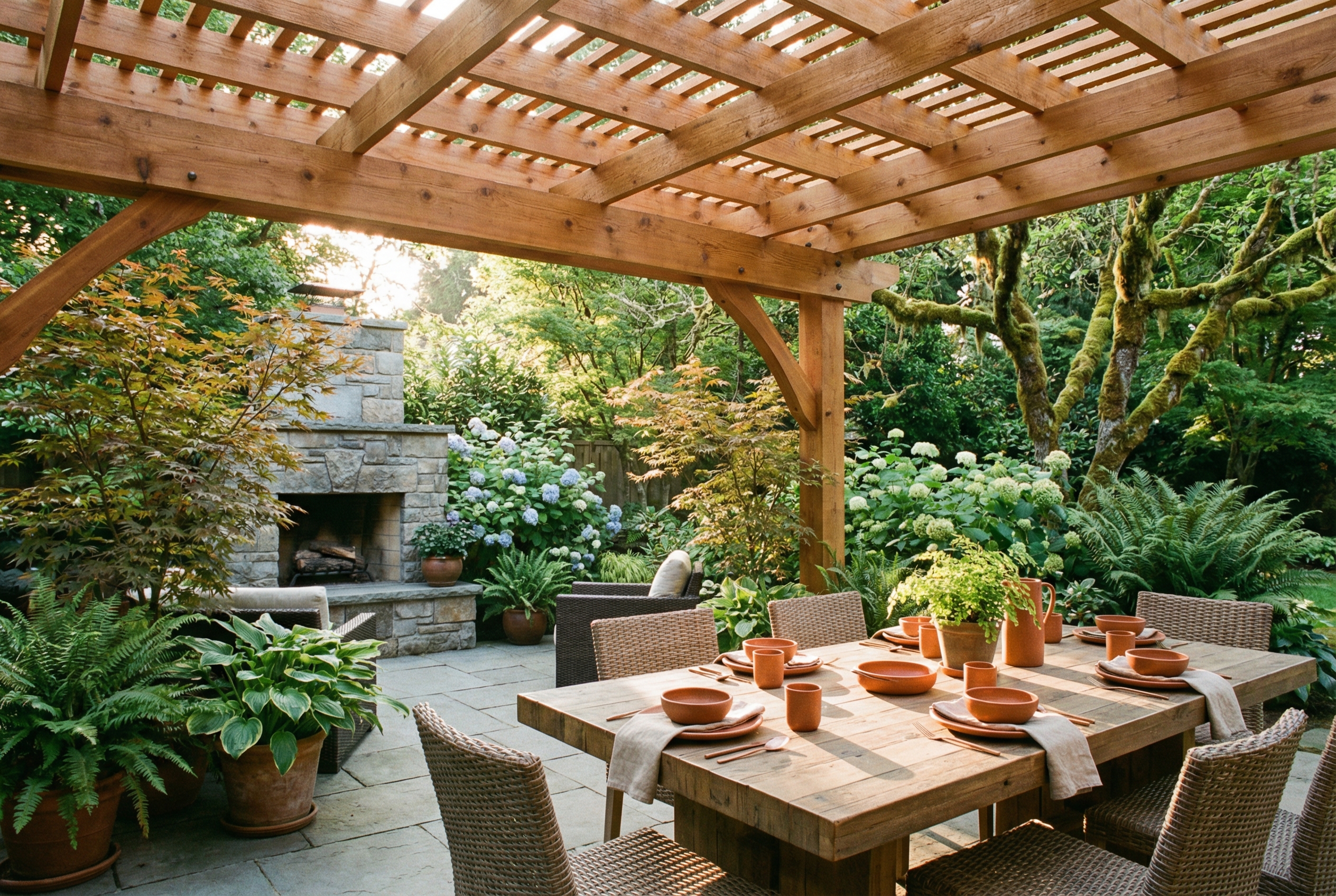
Any Style, Any Design: From classic dog-ear to modern horizontal, from simple picket to custom board-on-board, we build every wood fence style and can create custom designs to match your vision.
Staining Expertise: We know which stain products perform best in Portland’s wet climate and can apply professional-grade finishes during installation or advise you on the best DIY maintenance approach.
Frequently Asked Questions
Cedar is the premium choice — naturally rot-resistant, more dimensionally stable, and more attractive than PT pine. Pressure-treated pine costs less and offers excellent rot resistance through chemical treatment. Both perform well in Portland when properly installed and maintained. Choose cedar if aesthetics and natural materials are priorities. Choose PT pine if budget is the primary concern. We use PT posts for ground contact with either fence board material because PT posts are more resistant to below-grade rot.
Every 2-3 years for most Portland fences. South-and west-facing sections may need attention every 2 years due to higher UV exposure. North-facing sections accumulate more moss and should be cleaned before re-staining. We recommend penetrating oil-based stains (TWP, Penofin, Armstrong-Clark) that soak into the wood rather than film-forming stains that peel in Portland’s moisture cycle. A consistent staining schedule extends your fence’s life by 10+ years.
Board-on-board privacy fencing is our most requested style for backyard fences — it provides complete privacy while looking equally attractive from both sides. For front yards, picket fences remain the classic choice for Portland’s craftsman homes. In Portland’s inner neighborhoods (Sellwood, Alberta, Division, Mississippi), horizontal board fencing has become extremely popular for its modern, contemporary appearance.
UV radiation from sunlight breaks down the lignin in cedar’s surface cells, causing the warm amber-brown color to fade to silver-gray. This is a surface-only change that does not affect the wood’s structural integrity or rot resistance. Many Portland homeowners deliberately let their cedar fences weather to gray — it is a traditional Pacific Northwest aesthetic. If you prefer to maintain the original warm tones, apply a UV-blocking penetrating stain every 2-3 years.
Absolutely — horizontal fences are one of our most popular builds. We construct horizontal board fences with posts spaced 4-6 feet on center (closer than standard fencing) to prevent board sag. We use 1×6 or 1×8 cedar boards in clear or select grade for the best appearance. Horizontal fences are especially popular in Portland’s inner-city neighborhoods where they complement modern and mid-century home styles.
Ready to Get Started?
Schedule a free on-site consultation. We’ll assess your property, discuss your vision, and provide a detailed estimate — no pressure, no obligation.