
Custom Pergola Design & Construction
Architectural shade structures that define your outdoor space — built for Portland’s unique mix of summer sun and year-round rain.
Cedar Pergolas: The Pacific Northwest Classic
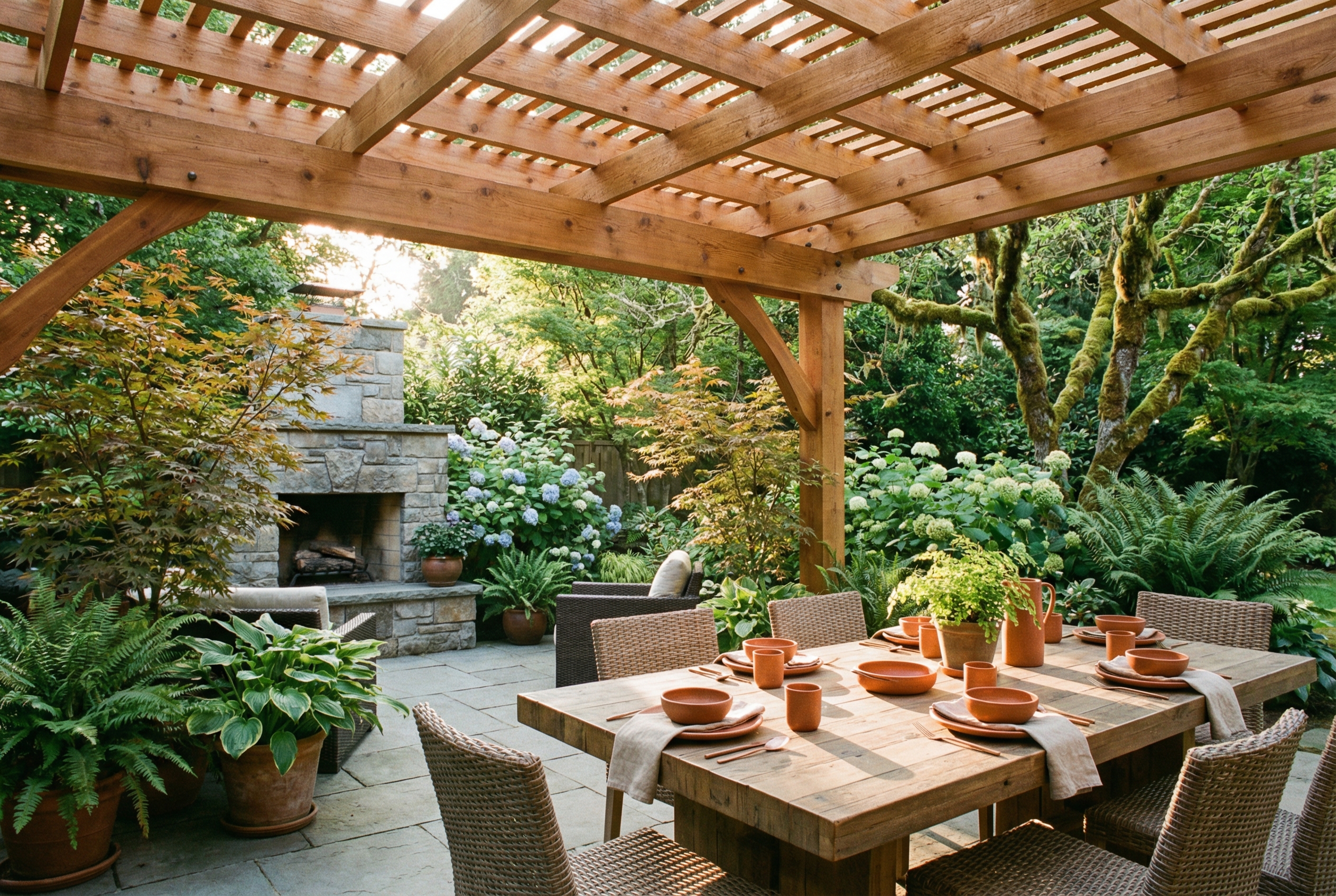
A pergola transforms an ordinary deck or patio into a defined outdoor room. It provides shade, frames your view, supports climbing plants, and anchors your outdoor living space with architectural presence. In Portland, where summer sun can be intense from June through September and rain returns with a vengeance in October, the right pergola design lets you extend your outdoor season in both directions.
Next Level Decks & Exteriors designs and builds custom pergolas in cedar, aluminum, vinyl, and combination materials. Every pergola we construct is engineered for Portland’s specific conditions — wind loads, rain exposure, snow loads, and the seismic requirements that Oregon building code demands. We handle design, permitting, construction, and finishing as a complete turnkey project.
Whether you want a grand attached pergola spanning your entire deck, a freestanding structure defining a garden dining area, or a modern aluminum pergola with a motorized louvered roof, we build it to last and look stunning.
80%
Shade Reduction
15+
Pergola Styles
Lifetime
Cedar Lifespan
Cedar Pergolas: The Pacific Northwest Classic
Western red cedar is the traditional pergola material in the Pacific Northwest, and for good reason. Its natural oils resist rot and insects without chemical treatment, it is dimensionally stable (minimal warping and twisting), and its warm amber-to-reddish tones complement Portland’s craftsman, mid-century, and contemporary architectural styles.
Cedar Grades: We build pergolas with select-grade or clear-grade Western red cedar, not the knotty construction-grade lumber you find at big box stores. Select-grade cedar has minimal knots, consistent grain, and smooth milling that looks beautiful with a natural finish. For larger beams and posts, we use rough-sawn cedar timbers (typically 6×6 posts and 2×8 or 2×10 rafters) that provide the mass and visual weight a pergola needs to feel substantial.
Finishing: Unfinished cedar will weather to a silver-gray patina within 12-18 months in Portland’s climate. Many homeowners prefer this natural aging look. If you want to maintain the original warm tones, we apply a penetrating oil stain (Penofin or TWP) at installation and recommend recoating every 2-3 years. A clear UV-blocking sealant is the minimum — it will not change the color but protects against surface graying.
Lifespan: A well-built cedar pergola in Portland will last 20-30 years. The posts are the most vulnerable component because they are closest to ground moisture. We install cedar posts on Simpson Strong-Tie elevated post bases that hold the wood above the concrete footing, eliminating ground-contact rot — the primary cause of premature pergola failure.

Aluminum Pergolas: Modern & Maintenance-Free
Aluminum pergolas have surged in popularity among Portland homeowners who want a modern look with zero ongoing maintenance. Powder-coated aluminum will not rust, rot, warp, fade, or need refinishing — ever. It is also significantly stronger pound-for-pound than wood, allowing for longer spans with slimmer profiles.
Fixed Roof vs. Louvered Roof: Aluminum pergolas come in two major categories. Fixed-roof designs have stationary rafters or panels that provide consistent shade. Louvered-roof designs (brands like StruXure, Equinox, and SolarSpan) feature motorized aluminum louvers that rotate from fully open to fully closed at the touch of a button. When open, they let sun and air through. When closed, they create a solid, waterproof roof that sheds rain. In Portland, louvered pergolas are particularly compelling because they handle both summer sun and winter rain seamlessly.
Integrated Features: Premium aluminum pergola systems offer built-in LED lighting, retractable screens, ceiling fans, and even heating elements — all integrated into the structure. The StruXure Pergola X, which we install regularly, includes a built-in gutter system that channels rain through the hollow posts to ground-level drainage, keeping the space below completely dry.
Cost: Aluminum pergolas range from $80-$150 per square foot for fixed designs to $120-$250+ per square foot for motorized louvered systems. A typical 12×16 louvered aluminum pergola runs $25,000-$40,000 installed. It is a premium investment, but the zero-maintenance, all-weather functionality often justifies the cost for Portland homeowners who want year-round outdoor living.
Vinyl Pergolas: Budget-Friendly & Clean
Vinyl pergolas offer a clean, white (or off-white) appearance at a lower price point than cedar or aluminum. They are manufactured from cellular PVC and reinforced with internal aluminum or steel channels for structural rigidity. Vinyl will not rot, split, peel, or require painting.
Best For: Vinyl pergolas work well for homeowners who want a traditional white pergola look without the maintenance of painted wood. They pair especially well with white vinyl fencing, colonial and Cape Cod architectural styles, and formal garden settings.
Limitations: Vinyl pergolas are available in limited colors (primarily white and tan) and limited structural configurations. They cannot span as far as cedar or aluminum without intermediate supports, and the thicker member profiles can look bulkier than natural wood. In Portland’s rare extreme heat events (like the 2021 heat dome), vinyl can soften slightly, though it returns to its original shape when temperatures normalize.
Cost: Vinyl pergola kits range from $3,000-$8,000 for standard sizes. Custom-built vinyl pergolas with professional installation typically run $5,000-$15,000 depending on size and features.
Attached vs. Freestanding Pergolas
Attached Pergolas: One end of the pergola connects directly to your house, typically using a ledger board fastened to the exterior wall framing. This creates a seamless transition from indoor to outdoor living and provides coverage right at the doorway where you step outside. Attached pergolas require proper flashing and waterproofing at the house connection — the same care we apply to deck ledger boards to prevent water intrusion into the wall cavity.
Freestanding Pergolas: Supported by posts on all four corners, freestanding pergolas can be placed anywhere in your yard — over a patio, in a garden, beside a pool, or at the edge of your property. They do not affect the house structure and typically do not require the same permitting complexity as attached structures. Freestanding pergolas can also be placed on concrete pads, paver patios, or directly on deck surfaces with proper post anchorage.
Permits in Portland: The City of Portland Bureau of Development Services generally requires a permit for pergolas that are attached to the house or exceed 200 square feet. Freestanding pergolas under 200 square feet and not in a setback area may be exempt, but we recommend confirming with BDS for your specific property. We handle the permit application and plan submission for every project that requires one.
Shade Analysis & Orientation
The direction your pergola faces determines how much shade it provides and when. In Portland, the sun tracks across the southern sky, reaching its highest angle (about 66 degrees) at the summer solstice and its lowest (about 19 degrees) at the winter solstice. Here is how orientation affects shade:
East-West Rafters (North-South Coverage): Rafters running east to west provide the most consistent midday shade because they block the high summer sun when it is directly overhead. This is the ideal orientation for south-facing decks that get intense afternoon sun from June through September.
North-South Rafters (East-West Coverage): Rafters running north to south provide dappled, shifting shade throughout the day as the sun moves from east to west. This orientation lets more winter sun through, which can be welcome in Portland’s gray months.
Rafter Spacing: The spacing between rafters controls shade density. Tighter spacing (12-16 inches on center) provides heavier shade — roughly 60-80% coverage at midday. Wider spacing (24-36 inches) creates a more open, airy feel with 30-50% shade. We discuss your shade goals during the design phase and adjust rafter spacing to match your preferences.
Climbing Plants: Many Portland homeowners train climbing plants on their pergola for additional shade and natural beauty. Wisteria, grapevines, climbing roses, and jasmine all thrive in Portland’s climate. The pergola provides the structural support while the plants fill in the canopy. We can add wire trellising or lattice panels to support plant growth.
Pergola Lighting & Accessories
Lighting transforms a pergola from a daytime shade structure into an evening gathering space. In Portland, where summer daylight lasts until 9:00 PM but winter dark falls by 4:30, good lighting extends your pergola season dramatically. Here are the options we install most frequently:
String Lights: The most popular and affordable pergola lighting option. Commercial-grade string lights with LED Edison bulbs draped between rafters create warm, inviting ambiance. We install permanent hooks and wiring runs so the lights are a fixture, not a temporary decoration.
Recessed/Surface LED: For aluminum and covered pergolas, recessed LED downlights integrated into the rafters or beams provide clean, directed illumination for dining and cooking areas. These are typically wired to a dimmer switch for adjustable brightness.
Pendant Lights: Hanging pendant fixtures add a more formal or decorative element. They work especially well on attached pergolas adjacent to outdoor dining areas.
Ceiling Fans: Outdoor-rated ceiling fans mounted between pergola rafters provide air circulation during Portland’s warm summer months (July-September) and help keep insects away during evening gatherings.
Retractable Canopies: Fabric canopy panels that slide along the rafters on stainless steel cables provide on-demand shade and light rain protection. When the sun is out, slide them open. When shade is needed, slide them closed. They are not waterproof enough for heavy Portland rain but handle light drizzle well.
Your outdoor space should be an extension of your home — not an afterthought.
Why Choose Next Level Decks & Exteriors
Custom Design for Every Home: We do not sell pergola kits. Every pergola we build is custom-designed for your specific space, architectural style, and outdoor living goals. Our design process includes shade analysis, material selection, and 3D visualization so you see exactly what you are getting.
Engineered for Portland: Our pergola designs account for Oregon’s seismic requirements, Portland’s wind loads, and the rain and snow loads specific to the Willamette Valley. Every structure is built to code and built to last decades.
Full Integration: We handle the complete scope — footings, structure, electrical, lighting, finishing, and accessories. No need to coordinate multiple contractors for a single project.
Material Expertise: With experience building in cedar, aluminum, vinyl, and hybrid designs, we help you choose the material that best fits your aesthetic, maintenance tolerance, and budget.
Frequently Asked Questions
In most cases, yes. The City of Portland Bureau of Development Services requires a permit for attached pergolas and for freestanding structures exceeding 200 square feet or located within setback areas. We handle the permit application, plan submission, and inspection coordination for every project that requires it, so you do not have to navigate the permitting process yourself.
A traditional open-rafter pergola provides approximately 50-80% shade depending on rafter spacing and orientation. Tighter rafter spacing (12 inches on center) provides heavier coverage, while wider spacing (24-36 inches) creates lighter, dappled shade. For full shade, we can add a retractable canopy, train climbing plants, or install a louvered aluminum roof that closes to provide 100% coverage.
Cedar and aluminum are both excellent choices for Portland. Cedar is the classic Pacific Northwest option — naturally rot-resistant, beautiful, and warm in appearance, though it requires periodic staining. Aluminum is the best choice for zero-maintenance performance — it will not rot, rust, or fade, and louvered aluminum roofs provide rain protection. Your choice comes down to aesthetic preference and maintenance willingness.
Yes. We regularly build pergolas on existing decks. Freestanding pergola posts can be anchored to the deck surface with heavy-duty post brackets bolted through the decking and into the substructure. For larger pergolas, we may extend post footings through the deck to independent concrete footings below. We evaluate your existing deck structure to ensure it can support the additional load.
A properly built cedar pergola using select-grade Western red cedar on elevated post bases will last 20-30 years in Portland’s climate. The posts are the most vulnerable component — our use of Simpson Strong-Tie elevated post bases keeps the wood above ground moisture, eliminating the ground-contact rot that is the primary cause of premature failure. Regular staining every 2-3 years helps maintain appearance and extends longevity.
Ready to Get Started?
Schedule a free on-site consultation. We’ll assess your property, discuss your vision, and provide a detailed estimate — no pressure, no obligation.