
Ipe & Hardwood Deck Builders in Portland
The premium choice for homeowners who want exceptional hardness, longevity, and exotic grain beauty.
The Premium Choice for Portland's Climate
Portland homeowners face a unique challenge when choosing decking materials. With over 150 days of measurable rainfall each year, persistent moisture, and temperature swings from summer highs in the 90s to winter freezes near 20 degrees, most materials are fighting an uphill battle from day one. Pressure-treated pine warps and splinters within a few seasons. Composite boards can sag, stain, and trap heat. Cedar softens and decays in our relentless damp without constant maintenance.
Exotic hardwoods are fundamentally different. Species like Ipe, Cumaru, Batu, and Tigerwood evolved in tropical rainforests where annual rainfall exceeds 80 inches and humidity rarely drops below 70 percent. These trees developed extraordinarily dense cell structures, natural oils, and chemical compounds that repel water, resist decay, and shrug off insect attack. When you install an exotic hardwood deck in Portland, you are putting a material that thrived in the Amazon basin into a comparatively mild climate.
At Next Level Decks and Exteriors, we have built our reputation on exotic hardwood decks throughout the Portland metro area. From the hillside properties of Southwest Portland to the backyards of Lake Oswego and the craftsman neighborhoods of Northeast, we bring the specialized tools, sourcing relationships, and expertise these materials demand. The result is a deck that will look stunning for 40 to 75 years or more.

71+
Projects Completed
5.0★
Average Rating
Lifetime
Warranty Protection
40-75 yr
Ipe Lifespan
$50-$80
Per Sq Ft
Class A
Fire Rated
Exotic Hardwood Species Guide
Each species brings a distinct combination of color, grain pattern, hardness, and price point. Choosing the right one depends on your aesthetic vision, budget, and how you plan to use your outdoor space. Below is a comparison of the five species we install most frequently.
| Species | Installed Cost (per sq ft) | Expected Lifespan | Janka Hardness (lbf) | Natural Color |
|---|---|---|---|---|
| Ipe (Brazilian Walnut) | $50 – $80 | 40 – 75+ years | 3,510 | Rich brown to olive, darkens with age |
| Cumaru (Brazilian Teak) | $45 – $65 | 30 – 50+ years | 3,330 | Golden tan to reddish brown |
| Batu (Red Balau) | $40 – $60 | 25 – 40+ years | 1,925 | Warm reddish brown |
| Tigerwood (Goncalo Alves) | $40 – $55 | 25 – 40+ years | 1,850 | Orange-brown with dramatic dark streaks |
| Garapa (Brazilian Ash) | $35 – $50 | 20 – 30+ years | 1,210 | Warm golden yellow |
All five species dramatically outperform domestic softwoods and composites in hardness, rot resistance, and longevity. The Janka hardness rating measures the force required to embed a steel ball into wood. For context, pressure-treated Southern Yellow Pine rates around 690 lbf and red oak comes in at 1,290 lbf. Even Garapa, our softest option, is nearly twice as hard as oak. Ipe at 3,510 lbf is more than five times harder than the pine decking found on most Portland homes.
Color is often the deciding factor. Cumaru offers a warm, honey-toned palette that pairs beautifully with Northwest modern architecture. Tigerwood makes a bold statement with striking dark grain lines against an orange-brown background. Garapa delivers a lighter, sun-bleached aesthetic at the most accessible price point in the exotic category.
Ipe: The Gold Standard in Decking
If exotic hardwoods are the premium tier of decking materials, Ipe sits at the very top. Also known as Brazilian Walnut, Ipe (pronounced EE-pay) is widely regarded as the finest decking wood available anywhere in the world. Its properties read less like a natural wood and more like an engineered material designed in a laboratory.
Ipe is so dense that it sinks in water. With a specific gravity of 1.05, that extreme density is the source of nearly every remarkable quality. Water cannot penetrate its tightly packed cell structure, making Ipe naturally waterproof without chemical treatment. Mold, mildew, and algae struggle to colonize the surface. Termites and carpenter ants cannot bore into it. In independent testing, Ipe has demonstrated rot resistance equivalent to the most aggressive chemical preservatives, achieved entirely through natural composition.
Ipe carries a Class A fire rating, the highest classification and the same rating given to concrete and steel. This is an inherent property of the wood, not a treatment or coating. For Portland homeowners in wildfire-prone areas near the West Hills or Forest Park, this fire resistance provides genuine safety value beyond aesthetics.
The lifespan of a properly installed Ipe deck is 40 to 75 years or more. Documented installations on the Atlantic City Boardwalk and commercial piers throughout Brazil have been in continuous service for over 50 years with minimal structural degradation. When we tell clients that an Ipe deck may be the last deck they ever build, we mean it literally.
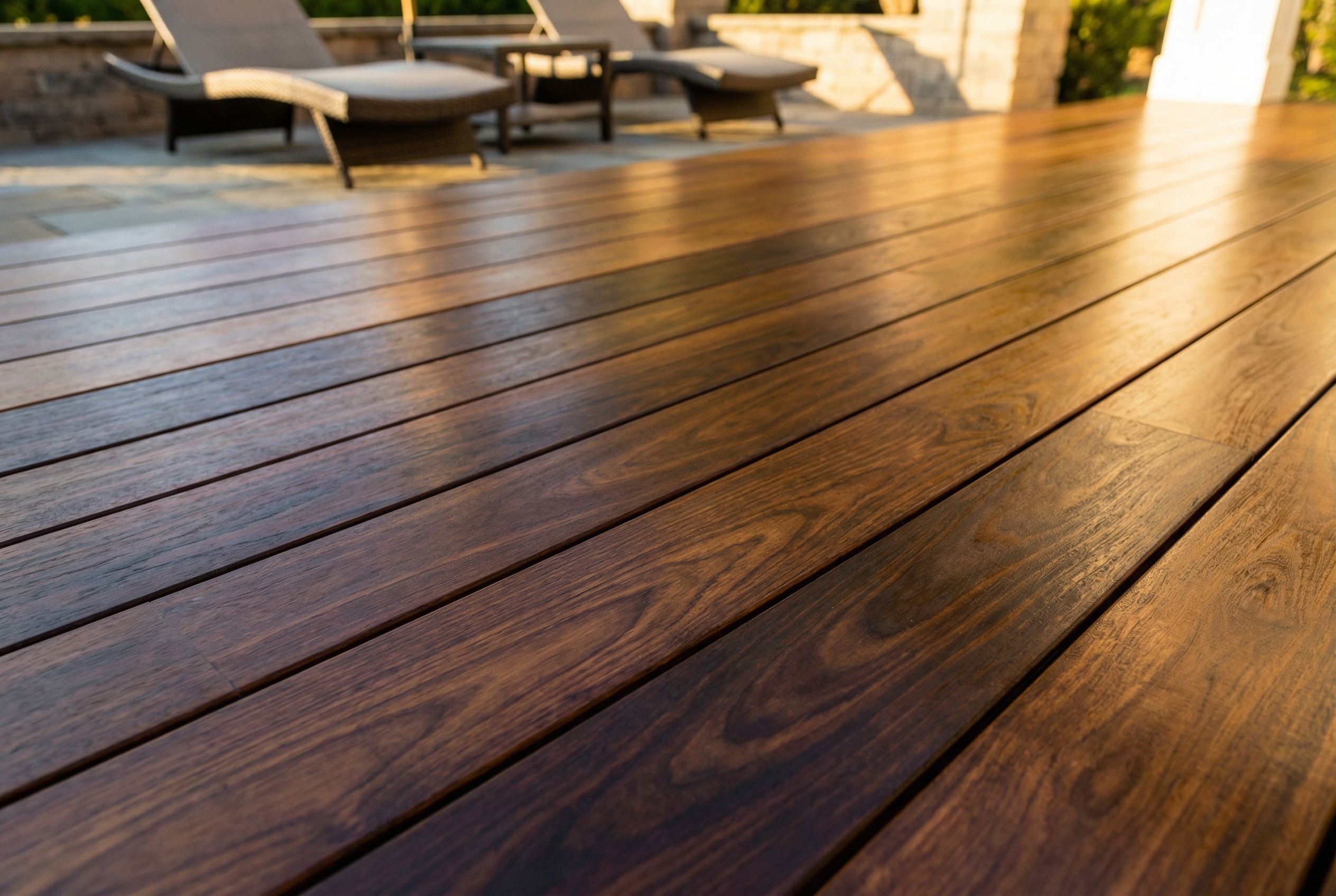
The rich, chocolate-brown color of freshly milled Ipe is stunning, with subtle grain variations ranging from olive undertones to near-black streaks. This visual depth gives Ipe a presence that photographs cannot fully capture.
Maintenance: Oil It or Let It Silver
One of the most common questions Portland homeowners ask about exotic hardwood decks is maintenance. The answer is refreshingly simple and comes down to a single aesthetic choice.
Option 1: Maintain the original color with oil. Apply a penetrating hardwood oil every 6 to 12 months to preserve the deep, warm tones of your chosen species. We recommend products formulated for dense tropical hardwoods, such as Penofin Exotic Hardwood Formula or DeckWise Ipe Oil. In Portland’s climate, annual application in late spring works best, after the heavy rains subside. The process takes a few hours: clean the surface, let it dry, and apply with a brush or roller. No sanding is required between applications.
Option 2: Let it weather to a natural silver patina. Skip oiling entirely and let the wood silver naturally. This is not neglect. It is a deliberate design choice embraced by architects and coastal property owners worldwide. The silvering affects only surface color. Structural integrity, hardness, rot resistance, and lifespan remain completely identical to an oiled deck. The silvered look pairs exceptionally well with contemporary Pacific Northwest architecture.
What you will never need to do with an exotic hardwood deck is stain it, seal it with film-forming coatings, sand it down every few years, or replace rotted boards. There is no annual pressure washing, no replacing popped nails, no worrying about splinters when your kids run across it barefoot.

Lifetime Cost Analysis: The Real Price of a Deck
The most frequent objection to exotic hardwood decking is upfront cost. When you see $50 to $80 per square foot for Ipe compared to $30 to $45 for premium composite or $15 to $25 for pressure-treated lumber, sticker shock is natural. But upfront cost is the wrong metric. The correct question is: what does this deck cost per year of useful life?
Here are the numbers on a 400-square-foot deck, a common size for Portland homes.
Pressure-treated pine: Installed cost of $6,000 to $10,000. Lifespan of 10 to 15 years, plus annual staining at $300 to $500. Over 50 years you build this deck three to four times. Total 50-year cost: $24,000 to $50,000, or roughly $1.20 to $2.50 per square foot per year.
Premium composite (Trex, TimberTech): Installed cost of $16,000 to $28,000. Lifespan of 25 years before fading and structural fatigue require replacement. You rebuild once in 50 years. Total 50-year cost: $32,000 to $56,000, or roughly $1.60 to $3.20 per square foot per year.
Ipe hardwood: Installed cost of $20,000 to $32,000. Lifespan of 50 to 75 or more years. Maintenance cost of $100 to $200 per year if oiled, zero if you let it silver. You build this deck exactly once. Total 50-year cost: $20,000 to $42,000, or roughly $1.00 to $1.60 per square foot per year.
The pattern is clear. Ipe is not the most expensive decking option over the life of your home. It is often the least expensive. That calculation does not even account for the disruption of tearing out and rebuilding a deck every 12 to 25 years: weeks without outdoor living space, contractor scheduling, waste hauling, and landscaping damage from demolition.
Exotic hardwood decks also add measurable resale value. Real estate agents in the Portland market report that high-quality outdoor living spaces are among the top features buyers seek, and a well-maintained Ipe deck signals quality throughout the entire property.
Installation Expertise That Makes the Difference
Exotic hardwood installation is not a project you hand to a general carpenter or attempt as a weekend DIY endeavor. The same density that gives these woods their incredible durability also makes them exceptionally demanding to work with. A single mistake can crack a board worth $8 to $15 per linear foot or create a structural weakness that will not reveal itself for years.
Pre-drilling is mandatory. You cannot drive a screw into Ipe or Cumaru without first drilling a pilot hole. Attempting to do so will snap the screw, split the board, or both. Our crews use self-centering drill bits calibrated to each species and fastener size, with every hole drilled to precise depth and diameter specifications.
Carbide-tipped blades are essential. Standard saw blades dull within minutes when cutting Ipe. We use industrial carbide-tipped blades designed for dense tropical hardwoods and swap them regularly throughout the project. Clean cuts matter for both aesthetics and structural integrity, as ragged edges can compromise joint precision.
Hidden fastener systems preserve the surface. We install most exotic hardwood decks using hidden fastener systems such as the DeckWise Ipe Clip or Camo Edge system. These grip the edges of each board from below, creating a smooth surface with no visible screw heads. For clients who prefer face-screwing, we use stainless steel trim-head screws countersunk and plugged with matching hardwood plugs.
Proper gapping and acclimation. Before installation, we acclimate lumber on site for a period appropriate to current conditions. Board spacing is calculated based on moisture content and Portland’s expected seasonal range, typically 3/32 to 1/8 inch gaps to accommodate expansion and contraction. Getting this wrong leads to buckling in wet months or excessive gaps in summer.
Stainless steel hardware throughout. Every bolt, joist hanger, and structural connector on a Next Level exotic hardwood deck is marine-grade stainless steel. The natural oils and tannins in tropical hardwoods corrode standard galvanized hardware, causing black staining and accelerated failure. This is a detail less experienced builders overlook, and the consequences appear within the first year.
Sustainability and Responsible Sourcing
We take the environmental responsibility of working with tropical hardwoods seriously. Every board we install comes with verified documentation of legal and sustainable harvest.
Our primary sourcing partners hold FSC (Forest Stewardship Council) certification, the most rigorous international standard for responsible forestry. FSC certification means the wood was harvested from forests managed according to strict environmental, social, and economic criteria. Harvest rates do not exceed natural regeneration. Indigenous community rights are respected. The chain of custody is documented from the forest concession through the mill, the distributor, and into our hands.
Responsibly sourced tropical hardwood is actually a net positive for forest conservation. FSC-certified concessions create economic incentive to keep forests standing rather than converting them to cattle ranching, soy farming, or slash-and-burn clearing.
We maintain chain-of-custody documentation for every project. If FSC-certified stock is unavailable for a particular species, we discuss alternatives with Lacey Act compliance and verified legal export permits. For clients who prioritize domestic materials, we also offer thermally modified ash and other heat-treated species that approach exotic hardwood durability.
Frequently Asked Questions
Request a free consultation and detailed estimate for your exotic hardwood deck project. We will visit your property, discuss species options, and provide a transparent quote with no hidden costs.
Build the Last Deck You Will Ever Need
Your outdoor space should be an extension of your home — not an afterthought.
Frequently Asked Questions
Ipe decks reliably last 40 to 75 years or more with proper installation. Real-world examples include the Atlantic City Boardwalk, where Ipe sections have been in service over 50 years under constant foot traffic, salt exposure, and coastal weather. In a residential setting, 50-plus years is a realistic expectation. The key is correct installation with stainless steel hardware, proper gapping, and adequate substructure ventilation, which is exactly what we provide on every project.
No. Oiling is entirely optional and purely cosmetic. Applying a penetrating hardwood oil every 6 to 12 months maintains the original rich color. If you skip oiling, the wood gradually weathers to an elegant silver-gray patina over 6 to 18 months. This silvering affects only surface appearance. Structural performance, rot resistance, hardness, and lifespan are identical whether you oil faithfully or never oil at all. Many clients oil for the first few years then let the deck silver naturally.
It comes down to replacement cycles. Premium composite costs $40 to $70 per square foot installed and lasts roughly 25 years, meaning two installations over 50 years. Ipe costs $50 to $80 installed and lasts 50 to 75 or more years — you build it once. Amortized over the full lifespan, Ipe runs approximately $1.00 to $1.60 per square foot per year compared to $1.60 to $3.20 for composite. You also avoid the cost and disruption of demolishing and rebuilding every quarter century.
We strongly advise against it. Exotic hardwood installation requires specialized tooling most homeowners do not own: carbide-tipped saw blades, self-centering pre-drill bits, hidden fastener jigs, and moisture meters calibrated for tropical species. Every screw hole must be pre-drilled to exact specifications or you risk splitting boards that cost $8 to $15 per linear foot. All hardware must be marine-grade stainless steel, as standard screws corrode and stain the wood within months. Professional installation protects your significant material investment and pays for itself many times over in avoided mistakes.
Exotic hardwoods are generally less slippery than composite decking when wet. The natural grain texture provides inherent traction that smooth-faced composites lack. Any outdoor surface can become slick when covered with algae or leaf debris, especially in Portland’s damp months. We recommend annual cleaning with a stiff brush and oxygen-based cleaner. For maximum traction, we can mill anti-slip groove patterns into the boards during installation.
Yes, and this is completely normal. All exotic hardwood species undergo UV-driven color change when exposed to sunlight. Ipe darkens from olive-brown to deeper chocolate, then lightens to silver-gray if left unoiled. Cumaru shifts from golden honey to warm brown before silvering. Tigerwood’s dramatic streaks mellow as the overall tone evens out. Annual application of a UV-inhibiting penetrating oil preserves the original color. If you let the wood silver, the transformation is gradual and even, producing a sophisticated weathered aesthetic many architects specifically seek out.
They can be, and we ensure ours are. We source from suppliers with FSC (Forest Stewardship Council) chain-of-custody certification, verifying harvest from responsibly managed forests at rates that do not exceed natural regeneration. FSC certification also ensures indigenous community rights and biodiversity protections are upheld. We maintain documentation for every project and provide it upon request.
Ready to Get Started?
Schedule a free on-site consultation. We’ll assess your property, discuss your vision, and provide a detailed estimate — no pressure, no obligation.